



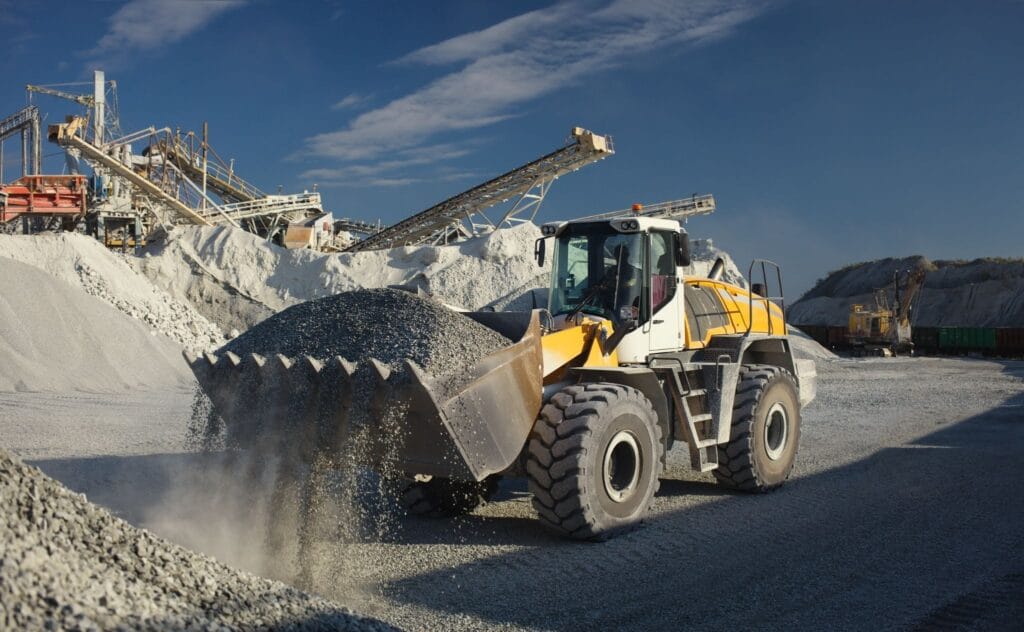
In challenging environments such as quarries, mines, and sawmills, which equipment truly maximizes profitability? Between the traditional loader and the articulated forklift, the choice directly impacts the total cost of ownership (TCO). Discover our full range of articulated rough-terrain forklifts through an objective analysis to understand how agility outperforms brute force for unit load handling.
Vehicle design: pushing and digging or lifting?
In material handling, two design philosophies compete depending on whether the priority is penetration force for bulk materials or precision in vertical lifting for unit loads. This fundamental distinction between the loader’s ability to “push and dig” and the articulated forklift’s ability to “lift and transport” directly determines the profitability of your operations in difficult terrain.
The loader: essential for pushing force and bulk materials
The loader is the go-to tool for pushing force and handling bulk materials. Its structure is specifically designed for excavation, pushing, and moving large volumes of material, such as soil or gravel, using its robust bucket.
Its articulation provides the agility needed to maneuver efficiently on job sites:
- its penetration power is designed to bite into material piles and fill the bucket quickly,
- its strategic balance maximizes frontal force, with the engine positioned far from the center, at the rear, acting as a natural counterweight without requiring additional ballast.
The articulated forklift: agility, heavy loads, and maximum stability
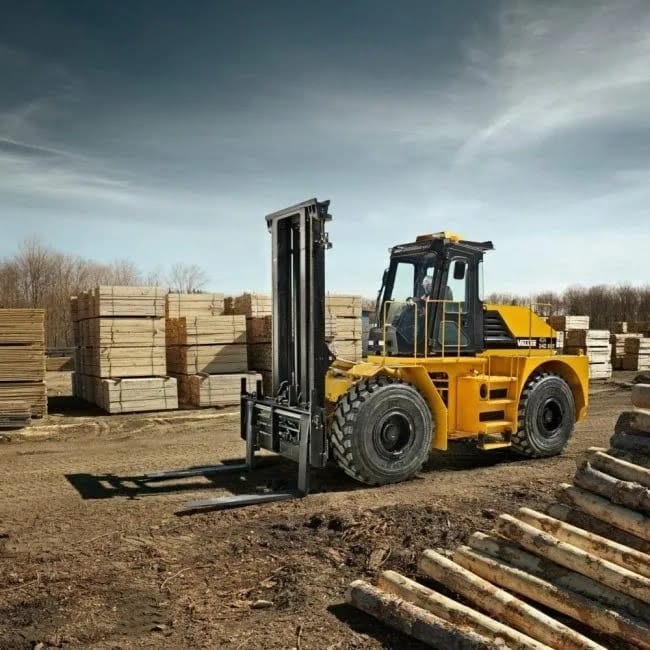
Conversely, the articulated forklift is built to optimize maximum stability and vertical lifting. Much more compact than a loader, it is designed to handle unit loads such as pallets and logs with surgical precision.
Its articulated geometry and 4×4 traction allow it to navigate agilely across rough terrain in mines or sawmills:
- unit handling: unlike bulk materials, it excels in the precise positioning of heavy loads,
- compact design: its counterweight is denser and closer to the load, ensuring optimal stability while remaining narrow enough to operate in confined aisles.
Learn more about articulated forklift technology.
Detailed analysis: 5 operational criteria in extreme environments
In demanding environments such as mines, forests, or quarries, choosing between a loader and an articulated forklift should not rely on habit, but on a rigorous productivity analysis. Here are five key criteria to guide your decision:
1. Capacity, stability, and lifting precision
The fundamental difference lies in design intent: the loader is built to push and dig, while the forklift is optimized to lift and place:
- load center: on a forklift, the load center is closer to the machine, ensuring greater stability and reducing real capacity losses when handling heavy loads,
- weight distribution: while the loader uses its rear engine as a counterweight to maximize digging force, the articulated forklift provides superior precision in positioning unit loads thanks to its high-strength mast,
- raw capacity: articulated vehicles can reach impressive capacities of up to 55,000 lb, competing with the most robust loaders while remaining more precise.
2. Mobility and traction: articulated performance on rough terrain
Agility is key in extreme environments. Unlike rigid frames, the articulated design splits the vehicle into two sections connected by a central pivot:
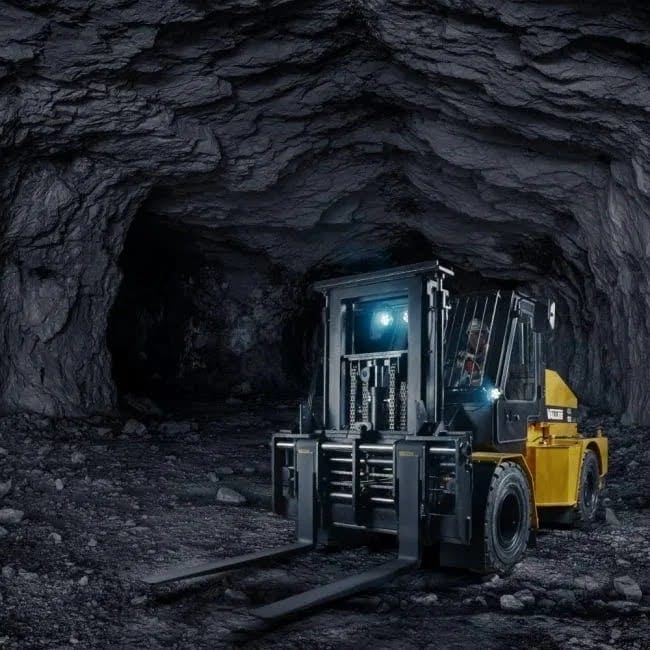
- hydraulic steering: using cylinders, the operator can steer the front independently from the rear, providing exceptional maneuverability in mining tunnels or crowded lumber yards,
- 4×4 performance: all-wheel drive is standard on models like the 4DA27E, allowing efficient work on unpaved, uneven, or muddy ground,
- responsiveness: articulation allows the forklift to “bend” laterally to navigate tight angles where a loader would be too bulky.
3. Storage density: space optimization through turning radius
Space optimization is a direct profitability lever. An articulated forklift is naturally much more compact than a loader of equivalent capacity.
A field study comparing 25,000 lb equipment revealed major space gains:
- aisle reduction: the forklift requires about 10 feet less in both length and aisle width compared to a loader,
- density gain: this compactness can increase storage density by up to 25% on the same site. In a real simulation, where a loader allowed only 3 aisles, the articulated forklift enabled 4 aisles within the same area.
Review the detailed case study on productivity and TCO.
4. Total cost of ownership: the long-term decision factor
The purchase price is only the tip of the iceberg. Total cost of ownership (TCO) includes fuel, maintenance, and actual productivity over 10 years. Data from the 25,000 lb study is clear:
- fuel savings: a forklift consumes on average 15 L/h compared to 20 L/h for a loader, a 33% reduction in diesel costs,
- maintenance and cycles: hourly maintenance costs are significantly lower ($11/h vs. $19/h). Loading cycles are 12.5% faster (15 seconds vs. 20 seconds),
- annual profitability: overall hourly cost drops by 22%, generating estimated savings between $20,000 and $40,000 per machine per year. Ultimately, the articulated forklift’s TCO is about 30% lower than a loader’s over a decade.
5. Versatility and durability: the importance of attachments and customization
The strength of manufacturer Vallée lies in its ability to transform standard equipment into specialized tools for your industry, whether forklifts or loaders:
- attachment expertise: with over 65 years of innovation, Vallée designs both universal (forks, lifting attachments) and specialized attachments,
- dedicated solutions:
- for mining: cable reels with powerful hydraulic motors,
- for forestry: combined grapples to handle logs and pallets with the same tool,
- in quarries: quarry booms up to 50 feet and heavy-duty rock buckets made of ultra-resistant steel,
- custom engineering: each machine can be configured (mast, cab, tires) to meet the unique challenges of your terrain.
| Criteria | Articulated Rough-Terrain Forklift | Wheel Loader | Strategic Impact in Rough Terrain |
|---|---|---|---|
| Primary Function | Vertical lifting and handling of finished loads (pallets, bundles, blocks). | Pushing force, digging, and transport of bulk materials (bucket, excavation). | Defines 80% of operational efficiency. |
| Compactness | Excellent: optimized design for lifting with a shorter vehicle. | Lower: uses a large engine positioned far from the central pivot as a counterweight. | 20% to 30% shorter for the same lifting capacity, optimizing storage yards and handling in confined spaces. |
| Maneuverability / Space | Excellent (articulated). Allows narrower aisles and increased storage density. | Good (articulated). Larger turning radius. | Key to yard optimization (up to 25% gain). |
| Load Stability | Load center closer (counterweight), mast optimized for height. Very stable when lifting. | Less stable at high stacking. Better for ground transport. | Crucial for safety and cycle speed. |
| Energy Consumption | Optimized, as the engine is sized for lifting tasks. | Higher consumption due to a more powerful engine required for digging and pushing. | 10% to 15% savings. |
| Operating Cost (TCO) | Generally lower (reduced consumption, faster cycles for unit loads). | Generally higher (high consumption and heavier maintenance). | Cost reduction of up to -22% per hour. |
| Operator Training | Standard forklift operator (simpler). | Loader operator (more complex). | Impacts workforce availability and labor costs. |
While the loader remains the king of moving bulk materials, the articulated forklift stands out as the most profitable and agile solution for unit-load handling in extreme environments. Discover our specialized attachments for forklifts and loaders.
Final choice for heavy industry applications
The choice between a loader and an articulated forklift is not about power alone, but about the nature of the load being handled. While the loader is a benchmark for moving bulk volumes, the articulated forklift excels at intensive unit-load handling.
When should you prioritize an articulated forklift?
It is the preferred tool for handling steel plates, containers, or lumber in production environments. Its exceptional agility allows precise positioning of machinery and smooth logistics in transfer yards or tunnels.
When should you use a loader?
It excels in heavy earthmoving and loading bulk materials such as aggregates, wood chips, or snow. Its versatility is enhanced by a quick coupler, allowing a switch from bucket to forks for occasional needs.
What should you choose: new, used, or rental?
To maximize profitability, manufacturer Vallée offers flexible acquisition solutions tailored to your financial and operational strategy:
- New equipment: the preferred option to achieve minimal total cost of ownership over the long term, benefiting from the latest innovations in energy efficiency and productivity,
- Used equipment: an option for immediate capital optimization, ideal for tighter budgets seeking robust, certified machines at a lower cost,
- Rental: whether short- or long-term, this solution offers maximum flexibility to manage seasonal activity peaks with predictable operating costs and no major upfront investment.
Conclusion
The articulated forklift stands out as the most profitable solution for unit load handling. Thanks to superior agility and faster cycles, it increases productivity by 14% compared to a loader. With a 30% lower TCO, it ensures optimal performance on rough terrain.
