



In the heavy-hauling and logistics sector, the North American context now imposes a dual constraint: strict profitability and environmental compliance, all under harsh climatic conditions.
In Canada, equipment performance in low temperatures is a fundamental criterion. In this context, the choice of your heavy-duty handling vehicle is more critical than ever. How do you choose between the zero-emission Vallée 4DA25-XRT electric and the power of the 4DA25D-XRT diesel? Through this comparison, discover the operating costs and return on investment of these two 25,000 lb giants to guide you within our complete range of forklifts.
Electric or diesel: which is the best choice for your business?
The best choice depends on your operational reality and your total cost of ownership (TCO).
Choose electric if:
- Major reduction in energy costs
- Indoor operations or sensitive environments
- Planned charging cycles
- Long-term TCO vision
Choose diesel if:
- Remote site without electrical infrastructure
- Continuous cycles without breaks
- Immediate refueling required
- Intensive field use without energy planning
What questions should you ask before choosing your rough terrain forklift?
Before committing your fleet for the next 10 to 15 years, it is essential to validate a few key points, including the following:
- climate performance: will the vehicle maintain its lifting capacity in extreme cold or harsh weather conditions?
- operational availability: how do you balance fast thermal refueling versus opportunity charging cycles (e.g., lunch breaks) for electric?
- operator experience: are acoustic comfort and maneuverability sufficient to ensure operator adoption?
Beyond increasingly strict environmental and regulatory constraints, the financial aspect is also central: with the operating cost of an electric forklift estimated at only 15% of that of a diesel forklift, savings can reach tens of thousands of dollars each year.
Why compare two equivalent models?
To ensure a fair comparison, the idea is to pit two machines with shared DNA against each other. By isolating the energy variable, the real impact of each powertrain on your profitability and operations becomes clear.
Regardless of the powertrain, both models share an identical technical foundation, ensuring uncompromised performance:
- lifting capacity: 25,000 lb at a 24-inch load center,
- identical robustness in design: articulated 4×4 structure with Axletech axles for extreme conditions,
- premium ergonomics: identical cab offering superior visibility and space,
- terrain versatility: proven capability for sawmills, lumber yards, and rough terrain.
By neutralizing these performance and comfort variables, the only major factor becomes the energy source, allowing for a precise measurement of the impact of switching to zero-emissions on your total cost of ownership (TCO).
Electric vs diesel forklift: two Vallée models under the microscope
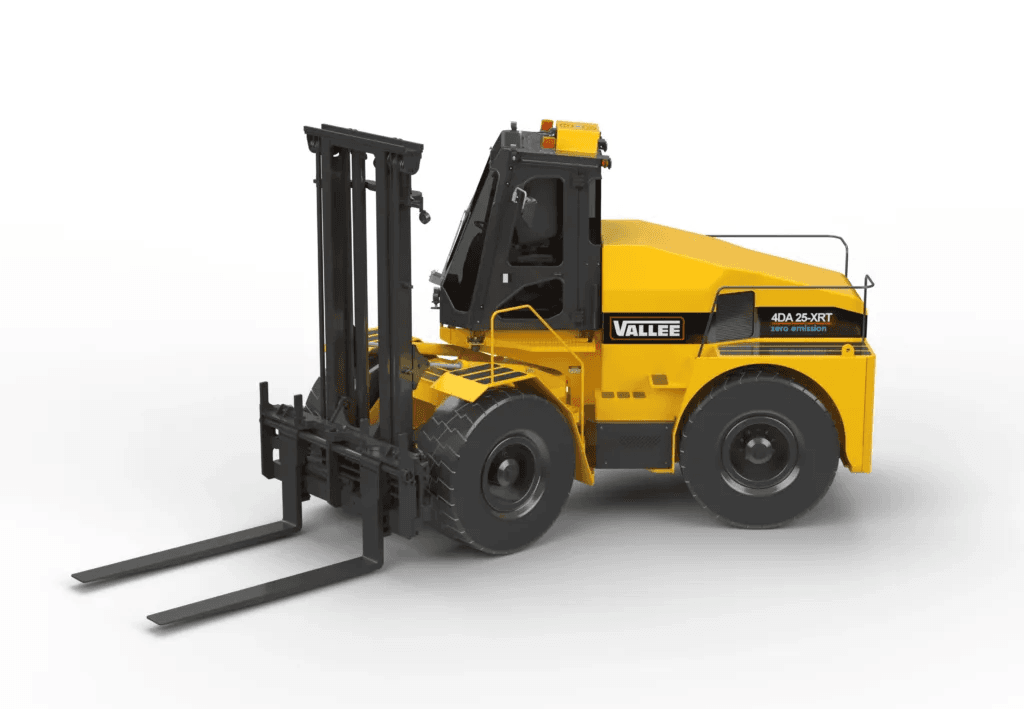
The Vallée 4DA25-XRT electric rough terrain forklift – Zero emissions
The future of heavy handling arrives with the Vallée 4DA25-XRT, a 100% electric powerhouse designed for the most demanding environments:
- equipped with a massive 500 kWh battery, it offers exceptional autonomy of up to 16 hours under normal conditions, covering two full work shifts.
- it produces zero CO₂ emissions during operation, making it a strategic asset to reduce operating costs while benefiting from Vallée’s expert support for your energy transition.
The Vallée 4DA25D-XRT diesel rough terrain forklift
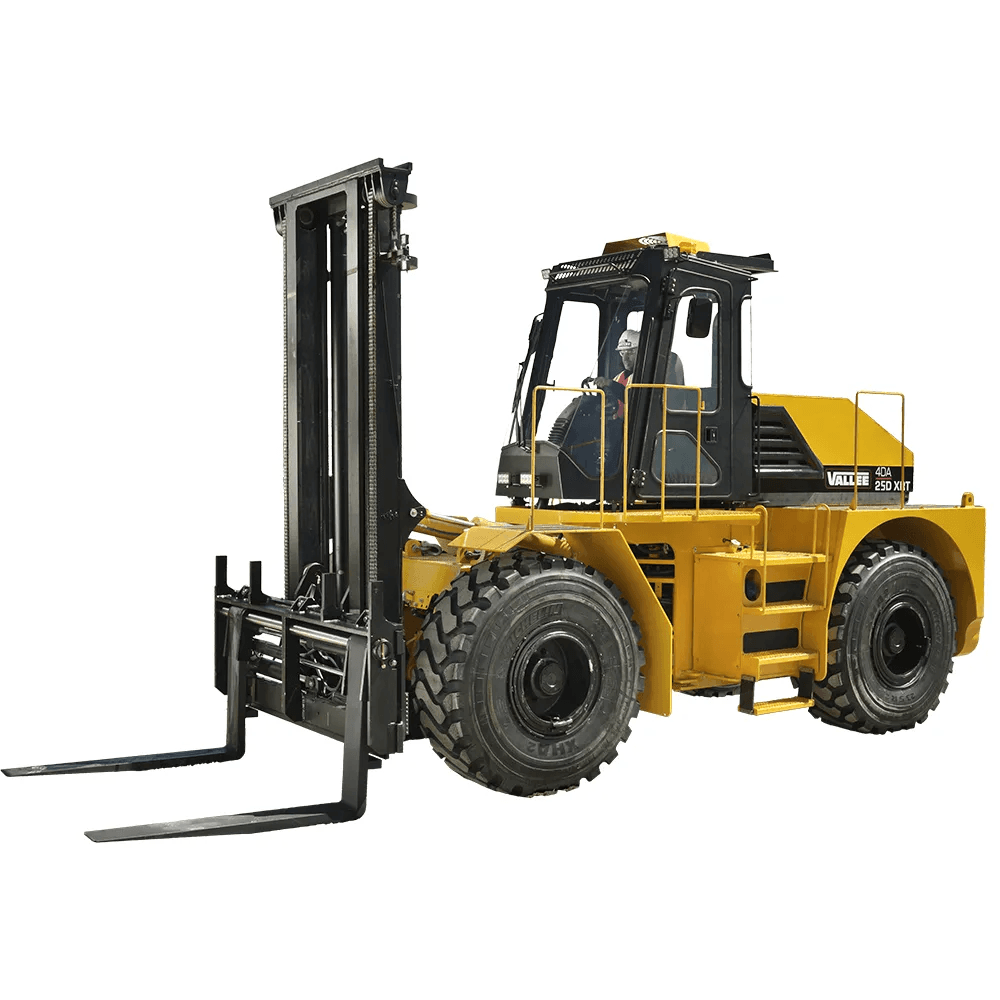
A true benchmark of power in the field, the Vallée 4DA25D-XRT is:
- powered by a Cummins QSB 6.7 Tier 4 engine with 173 hp. This robust machine, equipped with a proven Funk transmission, is specifically suited for intensive cycles and the toughest working conditions.
- a reliable and immediately available solution, it remains the preferred choice for those seeking constant raw power without relying on charging infrastructure.
Operating costs: the #1 criterion in 2026
In 2026, fleet profitability is no longer judged solely by purchase price, but by its ability to generate long-term savings. The electric vs thermal battle is now fought on every kilowatt-hour and every liter of fuel consumed.
Energy consumption
The economic advantage of electric is striking: electricity costs represent about 15% of the consumption of an equivalent diesel model.
For average use, this can translate into massive savings of up to $50,000 per year.
While diesel is subject to fuel price volatility, electric stabilizes your expenses. When calculating the Total Cost of Ownership (TCO), electric outperforms diesel, especially for companies operating two shifts (2 × 8 hours), where gains are amplified.
Downtime and productivity
While diesel offers fast refueling, it requires frequent stops for mechanical maintenance. In contrast, the electric model’s productivity is optimized through planned charging.
Thanks to opportunity charging (e.g., during lunch breaks), it is possible to keep the machine running without interrupting on-site operational flow.
Maintenance: simplicity vs heavy mechanics
The mechanical complexity of a thermal engine often leads to hidden costs and unexpected downtime. Electrification radically simplifies this equation.
Maintenance for the 4DA25-XRT electric model
The electric model stands out for its mechanical simplicity: with fewer moving parts, no combustion engine, and no oil changes, maintenance is reduced to the essentials.
Vallée also innovates with hydraulic energy recovery projects to extend battery life while maintaining an accessible design that simplifies servicing.
Maintenance for the 4DA25D-XRT diesel model
Diesel engine maintenance is heavier and more demanding, requiring regular replacement of filters and oil, as well as servicing of the fuel system. These frequent interventions demand advanced mechanical expertise and increase the risk of unexpected downtime.
What is the impact on machine availability?
In comparison, electric technology allows simplified planning and ensures better overall availability of your fleet.
Environment, regulations, and brand image
Environmental impact is now also a lever for performance and reputation. Adopting decarbonized solutions helps you meet regulatory requirements while enhancing your brand image.
Emissions and compliance
- Electric:
The electric model enables a reduction of at least 97% in CO₂ emissions during use, making it ideal for indoor sites or sensitive areas.
- Diesel:
In contrast, diesel engines generate noise, vibrations, and exhaust gases, necessitating costly ventilation. Electric offers a quiet and healthy working environment for operators.
Environmental responsibility and local impact
Choosing a Vallée forklift means supporting the local economy. Entirely manufactured and assembled in Quebec, these forklifts benefit from the “Made in Quebec” certification. This local commitment strengthens your corporate social responsibility and has a major positive impact on your image with clients and employees.
Field performance and usage conditions
Today, power is no longer exclusive to thermal engines. New electric technologies now rival diesel engines on the toughest terrains.
Capacity and robustness
It’s time to debunk the myth: electric is no longer limited to smooth warehouses. Both Vallée models offer identical 25,000-lb capacity, agile articulated steering, and all-terrain tires mounted on Axletech axles designed for extreme conditions. Vallée’s robustness is fully reflected in the electric version.
Extreme conditions
While diesel has historically excelled in continuous, intensive use, the Vallée electric model is now perfectly suited for lumberyards, sawmills, and rough terrain. Thanks to its ultra-robust design and high-quality components, it withstands extreme temperatures and rough ground, offering autonomy and reliability comparable to diesel.
Purchase price: investment vs profitability
Although the initial purchase price of a diesel model is generally lower, it comes with high long-term operating costs. Conversely, the higher upfront investment for an electric model is quickly offset by a faster return on investment through energy and maintenance savings. When evaluated based on total cost (TCO) rather than list price, electric emerges as the most profitable choice for your company’s future.
Electric or diesel in 2026: how to decide?
In 2026, the arrival of the first 100% electric Vallée forklifts marks a turning point. This crucial decision is no longer just about power, but must now integrate long-term sustainability and profitability goals. While both powertrains share Vallée’s robustness and agile articulated steering, they differ significantly in environmental impact, maintenance requirements, and energy supply methods.
Comparison table: electric or diesel?
Criterion | Vallée 4DA25-XRT (electric) | Vallée 4DA25D-XRT (diesel) |
Powertrain | 500 kWh battery | Cummins QSB 6.7 (173 hp) |
Autonomy / Refueling | Up to 16h (planned charging) | Fast refueling (a few minutes) |
Environmental impact | Zero emissions (-97% CO₂) | Emissions, noise, and vibrations |
Energy costs | About 15% of the diesel cost | Subject to price volatility |
Maintenance | Simplified (fewer moving parts) | Heavy (filters, oil, fuel system) |
Profitability (TCO) | Higher upfront cost, faster ROI | Lower purchase price, higher operating costs |
Choose electric if:
- you aim for cost reductions of up to $50,000 per year,
- your operations take place in indoor or mixed environments requiring silence and cleanliness,
- your company has strict sustainability and energy transition goals.
Choose diesel if:
- you operate on remote sites without charging infrastructure,
- your work cycles are ultra-intensive with no downtime for charging,
- you need immediate raw power without transition planning.
Conclusion
Ultimately, the “best” forklift is the one that aligns perfectly with your operational reality, budget constraints, and environmental commitments. Whether you choose electric innovation to maximize future profitability or diesel for continuous power, Vallée supports you with tailored solutions, designed and certified in Quebec, Canada. The key is to think in terms of Total Cost of Ownership (TCO) to ensure your company’s profitability and growth year after year.
