



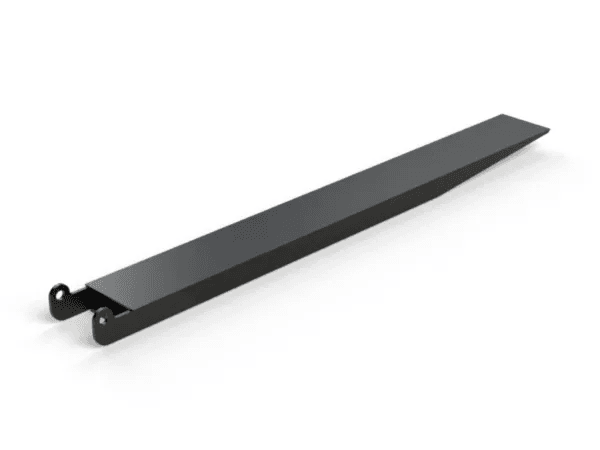
Out-of-spec loads, long pallets, bulky materials: some situations require extending your forklift’s forks. Extensions provide a practical and flexible solution… as long as they are used correctly. To properly install fork extensions, you must follow precise rules and never improvise. When poorly handled, fork extensions can alter your truck’s balance and turn a useful tool into a real risk.
The manufacturer Vallée supports you step by step to ensure safe and compliant material handling.
Fork extensions are safe if:
- they comply with the 1.5× original length rule,
- the residual capacity is validated,
- the load is centered and stable,
- they are removed after use.
What are forklift fork extensions?
Fork extensions are robust accessories designed to slide directly onto your equipment’s existing forks. They are intended for occasional, not permanent use, allowing you to instantly increase the usable fork length to stabilize oversized pallets or bulky materials.
It is crucial not to confuse extensions with more specialized equipment, such as telescopic arms, booms, or specific clamps. Unlike boom extensions, which create reach for lifting loads vertically or at an angle, extensions only affect horizontal length. Since each attachment has a different impact on stability, confusion can be dangerous.
When should you use fork extensions?
To ensure smooth handling, it is essential to identify situations where this accessory is appropriate:
Recommended situations:
- handling oversized pallets or bulky materials,
- reaching products stored deep in racking systems,
- a temporary and cost-effective solution for occasional needs.
Situations to avoid (use original long forks instead):
- handling heavy and repetitive loads,
- intensive, daily use,
- when machine stability is compromised by an excessively distant load center.
Impact of extensions on capacity and stability
Comparison table of extension impacts on a forklift
Characteristic | Impact with extensions | Operational consequence |
Load center | Shifted forward (further from the carriage). | Increases the risk of longitudinal tipping. |
Lifting capacity | Reduced (depending on the actual load center distance). | Risk of overload if relying on rated capacity. |
Lateral stability | Decreased, especially during turns or on slopes. | Requires reduced speed and wide turns. |
Maintenance | Extreme stress on load-bearing welds. | Inspection required at least every 6 months or depending on usage. |
For heavy and repetitive loads or intensive daily use, extensions are not recommended.
In these cases, it is much safer and more efficient to use longer original forks or a forklift with a higher rated capacity to minimize the risk of instability.
Safety rules and regulatory framework to follow
Fundamental safety principles
Compliance with the maximum length is essential:
- extensions must never exceed 1.5 times the length of the existing forks. This is a requirement of the B56.1 standard
- The load must always be properly distributed, and its weight must strictly match the capacity indicated on the attachment label.
Your installation and regulatory safety checklist
Before commissioning, the fleet manager and operator must validate the following key points:
1- Approval: obtain written authorization from the forklift manufacturer (OSHA 1910.178 standard),
2- Load plate: update data to reflect the new residual capacity,
3- Visual inspection: check for cracks, deformation, or weld wear,
4- Locking: ensure extensions are fully slid to the heel and secured with pins or retaining loops,
5- Length rule: confirm the extension does not exceed 1.5 times the original fork length.
Risks associated with improper use
Ignoring these rules exposes your company to serious consequences: truck overturning, load falling, and serious bodily injuries. Improper use compromises machine balance and can turn a work tool into a deadly hazard.
How to safely install fork extensions?
Preparation before installation
First, immobilize the truck and slightly lower the forks to the ground to facilitate insertion. Perform a visual inspection to check for any cracks and ensure the extensions are fully compatible with your forks in length and capacity.
Essential steps for safe installation
Align the extension with the fork, sometimes at a 45-degree angle to engage the tip, then slide it fully to the heel of the fork. It is then critical to secure them firmly using the provided devices, such as safety pins or retaining loops.
Final checks
Ensure the extensions are firmly seated against the fork heels and that there is no excessive play. Installation must be identical on both sides to maintain perfect symmetry and avoid imbalance during lifting.
Lifting a load with fork extensions: best practices
Load positioning
The load must be centered, stable, and evenly distributed across the entire length of the extensions to balance the weight. Absolutely avoid unbalanced or suspended loads at the tips of the extensions, as this increases leverage and the risk of tipping.
Safe lifting
Perform smooth, gradual lifting without jerks to avoid destabilizing the machine. Keep the load at the minimum necessary height for transport and continuously monitor the truck’s behavior to detect any signs of instability.
Traveling with a raised load
Adopt a reduced speed and anticipate maneuvers with wide turns. It is strictly forbidden to lift or handle loads on slopes or during sharp turns, as the shifted center of gravity makes the truck much more vulnerable to lateral forces.
Best practices for daily use
For long-term safety, adapt your driving by using very smooth acceleration and braking. Never exceed the calculated residual capacity, and most importantly: always remove the extensions after use. Never leave them installed “out of habit,” as they reduce visibility and unnecessarily affect handling when the truck is unloaded.
Inspection, maintenance, and lifespan of extensions
Regular inspections
Your extensions must be inspected at least every six months. This check should cover general wear, the appearance of cracks, metal deformation, and the integrity of load-bearing welds, which are subjected to extreme stress.
Immediate removal indicators
Remove the attachment from service if you observe any of the following:
- Visible deformation or bent metal.
- Cracks at support points or welds.
- Missing or unreadable capacity label (prevents safe lifting calculations).
- General doubt about the structural integrity of the extension.
Conclusion
Fork extensions redefine your forklift’s balance. Their value lies in the precision of their installation and the discipline of their use. Follow best practices, remove them after use, and never exceed calculated residual capacities. In material handling, sustainable performance always depends on risk control.
